What do the numbers on a hospital monitor mean?
A bedside monitor fits five or six measurements onto one screen, each in its own colour. Here is what every number stands for, the range you would expect in a resting adult, and the usual reasons it reads wrong.
Watch it on a monitor
Each number switched on one at a time, with its normal range.
Plays from YouTube when you click. Nothing loads from YouTube before that.
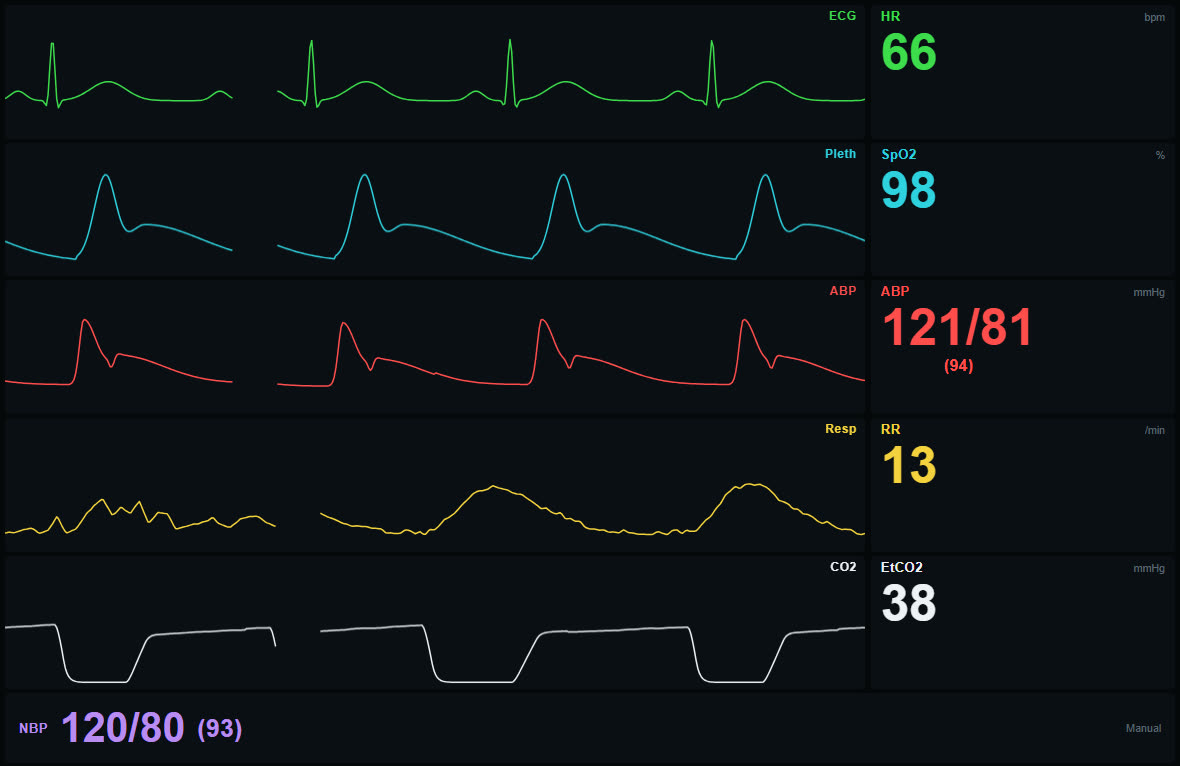
The screen above is a simulated monitor, but the layout is the one you meet on most wards and in most ambulances: waveforms on the left, the number that belongs to each one on the right, and a cuff blood pressure along the bottom. Many monitors, this one included, give each parameter its own colour and use it for both the curve and the number. The exact colours vary between manufacturers, so learn them on the monitor you actually work with.
HR: heart rate
Beats per minute, counted from the ECG. A resting adult usually sits between 60 and 100. The number is only as good as the ECG signal behind it. Loose electrodes, shivering or a patient brushing their teeth can make the monitor count noise as beats. Many monitors also count the pulse from the finger probe, and when the two disagree, for example in atrial fibrillation where some beats are too weak to reach the finger, that difference is a finding in itself.
SpO2: oxygen saturation
The percentage of haemoglobin in arterial blood that is carrying oxygen, measured with light through a finger or earlobe. Healthy adults are usually at 95 to 100 percent. Some patients with chronic lung disease are deliberately kept lower, often 88 to 92 percent, on a doctor's instruction. Before trusting the number, look at the pleth curve beside it. A clean, regular pulse wave means the probe sees real blood flow. A flat or ragged one usually means cold hands, poor circulation or a probe that has slipped, and then the number means very little. The SpO2 page goes into more detail.
ABP: the arterial line
Only there when the patient has an arterial catheter, usually in the wrist. It shows systolic over diastolic pressure in mmHg, updated with every heartbeat, and the mean arterial pressure (MAP) in brackets. Around 120/80 is a typical resting value. Intensive care units often aim for a MAP of at least about 65 in critically ill patients, because the organs start to lose perfusion below that. The curve matters as well: a small notch on the way down, the dicrotic notch, is a sign of a trustworthy trace.
NBP: the cuff pressure
Non-invasive blood pressure from an inflatable cuff. Unlike the arterial line it is not continuous. It is a single measurement, taken when someone presses start or when the automatic interval comes round, and it stays on the screen until the next one. So check how old it is. A pressure from half an hour ago says little about the patient in front of you. Why the cuff and the arterial line can disagree is covered in NBP vs ABP.
RR: respiratory rate
Breaths per minute, typically 12 to 20 for an adult at rest. Monitors get it either from tiny changes in electrical resistance across the chest, picked up through the ECG leads, or from the CO2 curve. The chest method is easily fooled by movement and talking, so if the number looks strange, count the breaths yourself for 30 seconds.
EtCO2: carbon dioxide at the end of each breath
The CO2 level at the very end of each exhaled breath, shown in mmHg or kPa depending on the country. Normal is about 35 to 45 mmHg, roughly 4.5 to 6 kPa. It reflects breathing, but also circulation, because CO2 has to be carried to the lungs before it can be breathed out. That is why a sudden fall is taken seriously, and why a sharp rise during CPR can be the first sign the heart has started again. The shape of the curve tells you as much as the number; see the capnography page.
The three numbers most people mean
When a visitor asks about "the three numbers", they usually mean heart rate, oxygen saturation and blood pressure. Those are monitored on almost every patient. Respiratory rate and EtCO2 are added when breathing is a concern, and the arterial line mostly belongs to intensive care and the operating theatre.
Why a number can be wrong
- A sensor has moved or lost contact: an ECG electrode, the finger probe or the cuff.
- The patient is moving, shivering or talking.
- Cold hands or poor circulation, which makes SpO2 unreliable.
- An old reading, which happens a lot with the cuff.
- An irregular rhythm, which can confuse both the heart rate count and the cuff.
An alarm is not a diagnosis. Staff look at the patient first, then at the waveform, and only then at the number. If you are sitting with a relative and something beeps, ask the nurse.
Learning to read them
The numbers stick fastest when you watch them change. With a free simulator like this one, an instructor sets the values on a phone and the monitor on a tablet follows, so a student can watch the saturation fall, the pleth flatten or the EtCO2 drop and say what they think is happening. For a step-by-step way through the whole screen, read how to read a patient monitor.
Frequently asked questions
What are the 3 numbers on a hospital monitor?
Usually heart rate, oxygen saturation (SpO2) and blood pressure. Many monitors also show respiratory rate, and in intensive care often an arterial pressure with MAP and an EtCO2 value.
What is a normal heart rate on a hospital monitor?
For a resting adult roughly 60 to 100 beats per minute. Fit people can be lower, while fever, pain or blood loss push it up.
What is the number in brackets under the blood pressure?
The mean arterial pressure (MAP), an average pressure over the whole heartbeat. Intensive care units often aim to keep it above about 65 mmHg.
Is the monitor in the picture a real medical device?
No. It is a free training simulator. An instructor sets the values, and they have nothing to do with a real patient.
Last updated