NBP vs ABP: what is the difference?
Most monitors can show two blood pressures at once. One comes from a cuff around the arm, the other from a thin catheter in an artery. They measure the same thing in very different ways, which is why the numbers rarely match exactly.
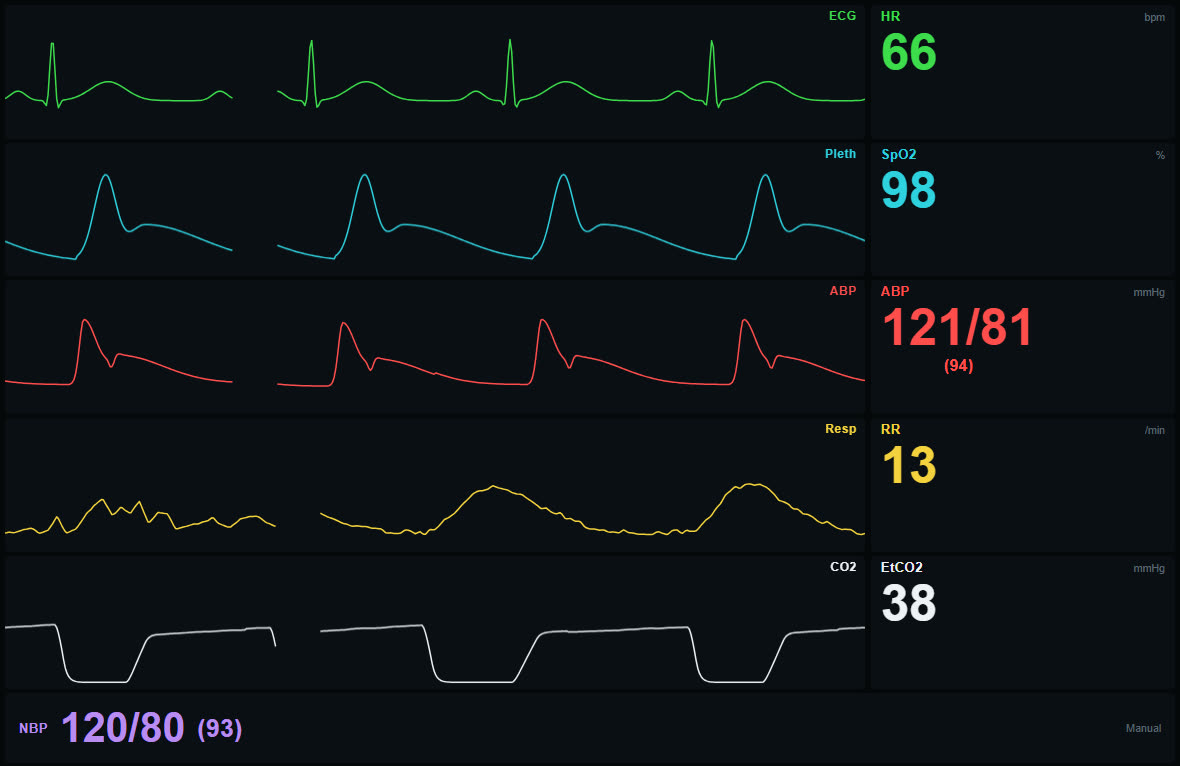
Watch it on a monitor
The pressure drops: the arterial line follows, the cuff keeps the old value until it measures again.
Plays from YouTube when you click. Nothing loads from YouTube before that.
NBP: the cuff
NBP stands for non-invasive blood pressure, also written NIBP. The monitor inflates the cuff until blood flow in the artery stops, then lets the air out slowly and senses the small pressure oscillations in the cuff as blood starts to flow again. Most modern monitors work this way, a method called oscillometry. The oscillations are strongest around the mean arterial pressure, so the MAP is what the cuff measures most directly. The monitor's algorithm then works out systolic and diastolic from there.
- Intermittent: one value per measurement, either on demand or on an automatic interval.
- Each measurement takes a while, and the value stays on screen until the next one.
- Simple and safe, so it is used on almost every patient.
- Less reliable with irregular rhythms, shivering, movement, very low pressures or a cuff of the wrong size.
ABP: the arterial line
ABP, arterial blood pressure, often called IBP for invasive blood pressure, is measured through a catheter in an artery, usually the radial artery at the wrist. The catheter connects through fluid-filled tubing to a pressure transducer, which turns the pressure into an electrical signal. The result is a curve and a fresh value with every single heartbeat.
- Continuous: a drop in pressure shows up the moment it happens.
- Shows the arterial waveform, which carries information of its own.
- Lets staff take blood samples without a new needle each time.
- Invasive, so it is used mainly in intensive care, in theatre and for very unstable patients.
- Needs looking after: the transducer has to be zeroed and kept level with the heart, or every value is off.
Why the two numbers differ
A few mmHg apart is normal. The methods differ, the cuff sits on the upper arm while the catheter usually sits in the wrist, and the pressure wave actually changes shape as it travels out through the arteries. Systolic pressure in the wrist is often somewhat higher than closer to the heart, while the MAP stays much the same along the way. That is why many clinicians compare the MAP between the two rather than the systolic.
Bigger gaps usually have a technical cause:
- The transducer is at the wrong height. Too low reads high, too high reads low.
- The arterial line is damped by an air bubble, a clot or a kinked line. The curve looks soft and rounded, the systolic reads too low and the diastolic too high.
- The opposite, an underdamped system, gives a spiky curve that overestimates the systolic.
- The cuff is the wrong size. Too small reads high, too large reads low.
- An irregular rhythm such as atrial fibrillation, which the cuff struggles with.
Which one to trust
If the arterial curve looks right, with a sharp upstroke and a clear dicrotic notch, and the transducer has been zeroed and levelled, the arterial line is usually the best measure of the pressure right now. If the curve looks damped or odd, check the system first and use a cuff reading to cross-check. When the two disagree and nothing technical explains it, look at the patient.
How the simulator handles it
In this simulator one slider on the controller sets the pressure for both, which is why it is labelled ABP (NBP). The arterial line updates continuously with a realistic curve and MAP, while the cuff value only changes when a measurement is taken, on demand or at the chosen interval. The cuff takes about fourteen seconds, and in a pulseless rhythm it fails instead of giving a number. Students learn the difference that matters most in practice: the cuff shows what the pressure was, the arterial line shows what it is. The arterial line page and the cuff page go into more detail.
Frequently asked questions
What is the difference between NBP and ABP?
NBP is measured now and then with a cuff around the arm. ABP is measured continuously through a catheter in an artery, with a new value for every heartbeat and a pressure curve.
Is it normal for NBP and ABP to differ?
A few mmHg is normal. Compare the MAP rather than the systolic, since the systolic in the wrist is often higher than closer to the heart. Larger gaps usually have a technical cause, such as a damped line, a transducer at the wrong height or the wrong cuff size.
What does NIBP mean?
Non-invasive blood pressure, the same thing as NBP: blood pressure measured with a cuff instead of a catheter in an artery.
Which is more accurate, the cuff or the arterial line?
A well-working arterial line that is zeroed and levelled is usually the more reliable measure, and it is continuous. If its curve looks damped, check the system and cross-check with the cuff.
Last updated