How to measure respiratory rate correctly
Respiratory rate is the vital sign most often estimated rather than counted. Doing it properly takes one minute and a watch, and it is often the first number to change when a patient is getting worse.
Step by step
- Let the patient settle. Talking, walking to the bed or getting upset all speed breathing up for a while.
- Don't announce it. People breathe differently once they know they are being watched. A common trick is to count straight after the pulse and keep your fingers on the wrist, so it looks as if you are still taking the pulse.
- Watch the chest or the belly. One rise and one fall is one breath. If breathing is shallow, look at the shoulders or rest a hand lightly on the chest.
- Count for a full 60 seconds. Counting for 15 seconds and multiplying by four turns one missed breath into an error of four. Irregular breathing needs the whole minute.
- Note more than the number: depth, rhythm, effort (neck muscles, flaring nostrils, can the patient finish a sentence) and any sounds such as wheeze or gurgling.
Normal values
A healthy adult at rest breathes about 12 to 20 times a minute. Early warning scores weigh deviations heavily. In NEWS2, 12 to 20 scores 0, 9 to 11 scores 1, 21 to 24 scores 2, and 8 or less or 25 or more scores 3, the highest a single parameter can give. Children breathe faster the younger they are, so use an age-specific chart for them.
Why it matters
A rising respiratory rate is often one of the earliest signs that something is wrong: sepsis, a metabolic acidosis, heart failure, pulmonary embolism or simply pain. It frequently changes before blood pressure or saturation does. A falling rate after opioids or sedation is just as important. That is why a rate written down from habit, the same "16" on every chart, is a real problem and not just sloppiness.
What the monitor counts, and where it goes wrong
Most bedside monitors measure respiration through the ECG electrodes. They send a tiny current across the chest and register how the electrical impedance changes as the lungs fill and empty. That works well on a calm patient, but:
- Movement, talking and coughing can be counted as breaths.
- With shallow breathing the heartbeat's ripple on the curve can be counted as breathing.
- In obstructive apnoea the chest keeps moving against a closed airway, so the monitor can show breathing while no air moves at all.
Capnography counts real exhaled CO2 and is much more reliable for spotting apnoea. Whenever the RR number does not fit the patient in front of you, count yourself. More about each number in what do the numbers on a hospital monitor mean.
Practising with the simulator
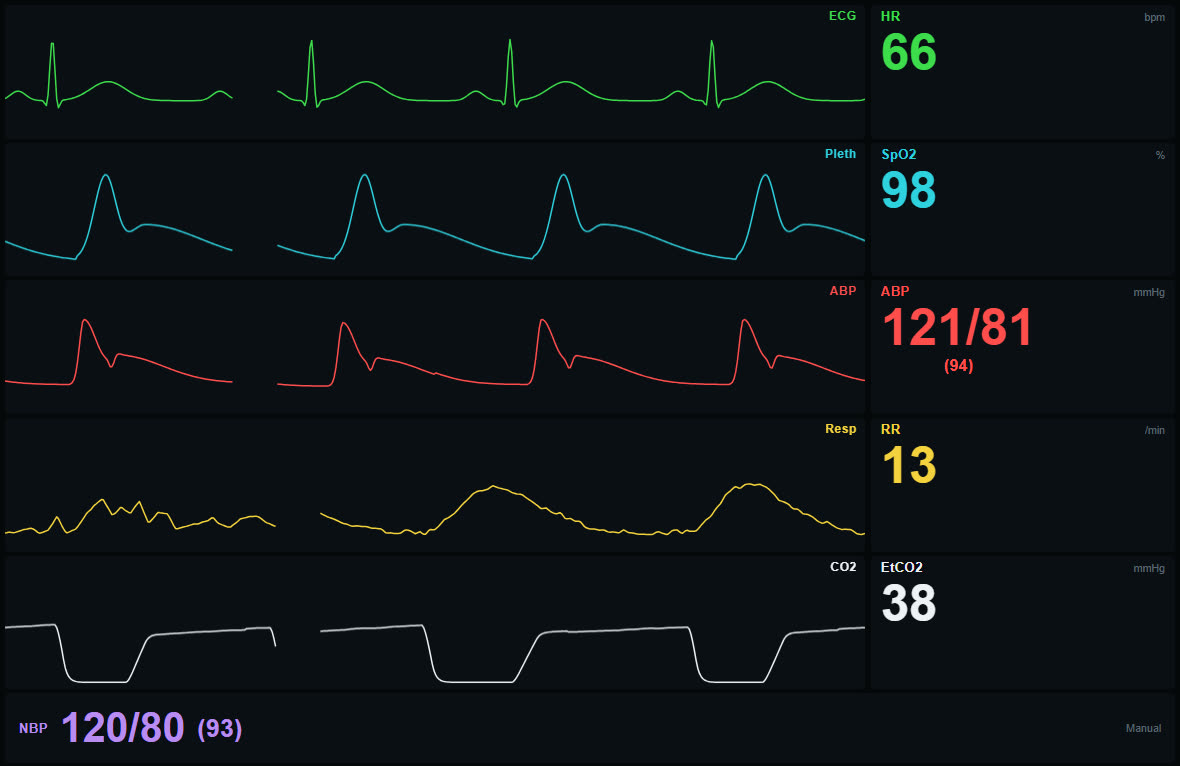
The respiration curve in this simulator is not a smooth sine wave. Breaths vary in length and depth, there are occasional sighs, and a talking artifact makes the trace shallow and choppy, the way a real one looks. A simple exercise is to have students count for a full minute from the curve and then compare with the number on screen. The respiration page describes how the curve is built.
Frequently asked questions
What is a normal respiratory rate?
About 12 to 20 breaths a minute for an adult at rest. Children breathe faster, and the younger the child, the higher the normal rate.
Should you count respirations for 30 or 60 seconds?
A full 60 seconds. Short counts multiply every mistake, and irregular breathing cannot be judged from a few breaths.
Why should the patient not know you are counting?
People change how they breathe when they know someone is watching, which makes the count less accurate.
Last updated