Building a nursing skills lab on a tight budget
A skills lab doesn't need every line item on the equipment catalog in year one. It needs the handful of things that let students practice what they'll actually be tested on, plus a plan for adding the rest later.
Start with what the lab has to do, not what's for sale
Equipment catalogs are built to sell equipment, not to run a program. Before any budget conversation, write down the actual skills the curriculum tests this term: starting an IV, auscultating lung sounds in four positions, recognizing a deteriorating patient, giving a clean SBAR handoff. Every dollar should map to one of those skills. A feature that doesn't map to anything on that list is a nice-to-have, however good it looks in a sales demo.
The essential tier: buy this first
A handful of items cover most of what a new program needs, and none of them require a six-figure budget.
- A bed or gurney students can work around on every side, not a desk pushed against a wall. Assessment depends on approaching a patient from more than one angle.
- A task trainer torso for the physical skills tested most often: IV access, auscultation landmarks, basic airway positioning. A torso costs a fraction of a full manikin and covers psychomotor skills a screen never will.
- A way to display vital signs that an instructor can change mid-scenario without a technician running a console. This is the cheapest item on the whole list, and the one new programs skip most often, because a phone propped on a stand doesn't look like "simulation equipment" in a catalog. It should still behave like a real monitor: a blood pressure cuff that takes its time instead of reading out instantly, an SpO2 trace that drifts instead of snapping to a new number.
- Documentation basics: a chart, a medication administration record, and a way for students to practice an SBAR handoff, on paper or on a tablet.
- Moulage supplies: fake blood, a basic wound kit, and whatever wearable simulators match what the curriculum actually covers that term.
The nice-to-have tier: let it wait
These earn their place eventually. They rarely earn it first.
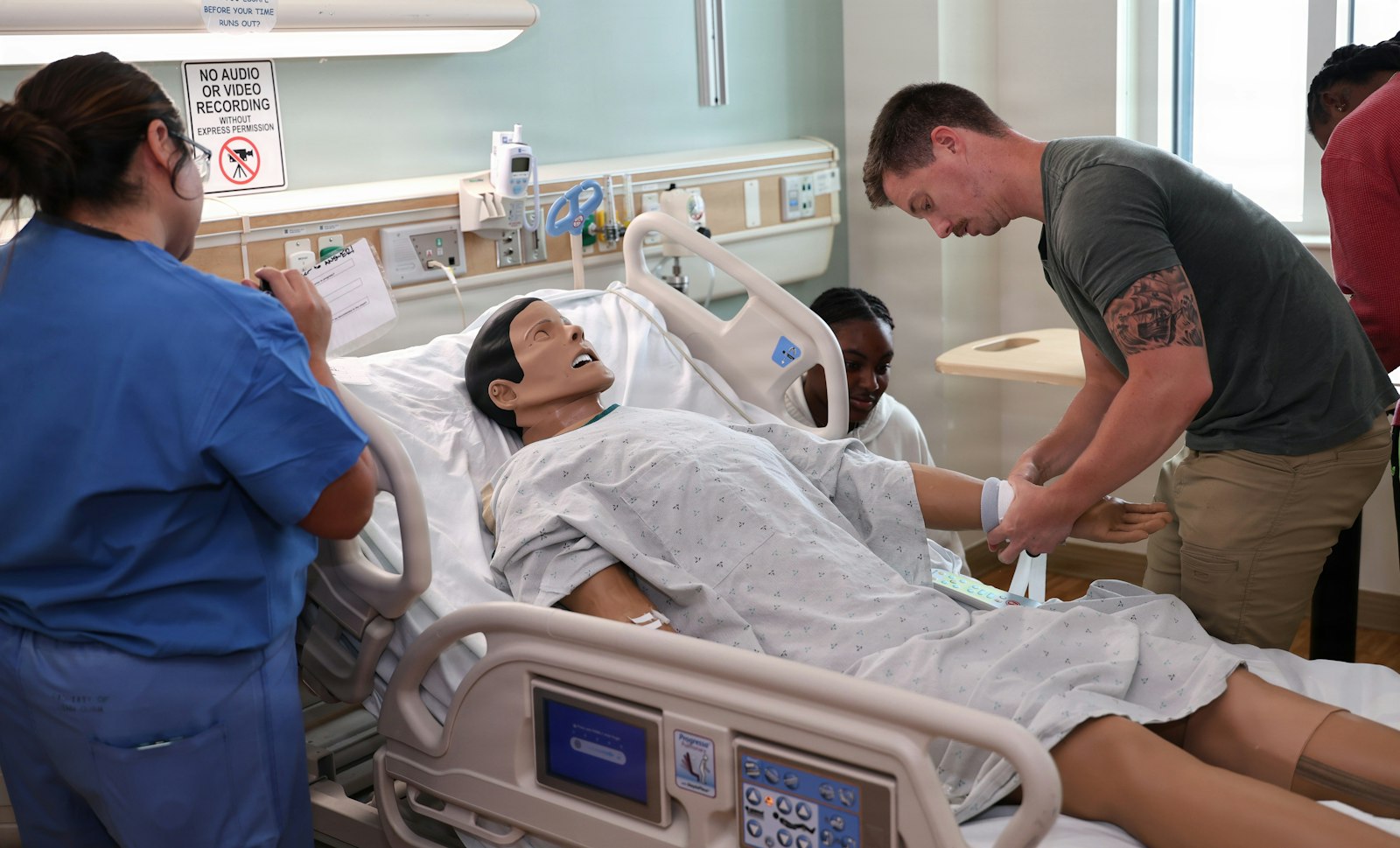
- A high-fidelity manikin with programmable physiology, pupil response and built-in vital signs. It's the item every open house photo features, and the one that eats the largest share of a first-year budget if it's bought before the basics above are covered.
- A dedicated control room with one-way glass. Useful once a program is running several scenarios a week. Not useful for a first cohort of ten students.
- Multi-camera recording for structured debrief playback. Valuable once debrief technique is already solid. A pointless expense if the debrief itself still needs work.
- Several simultaneous bays. One working station that students rotate through beats three half-equipped ones.
Where a free monitor simulator fits
The vital signs display in the essential tier above doesn't have to be expensive, or even a separate line item. The Patient Simulator runs on two phones or tablets over the internet: one shows the bedside monitor, the other is the instructor's controller, and a program can run it on devices students and faculty already own. It covers exactly the recognition half of training in that list: a rhythm the student has to read off a simulated ECG rather than a label, a blood pressure that changes gradually instead of jumping, an SpO2 reading that can drift on its own for a poor-perfusion scenario. For a program running its first scenarios in a borrowed room with two phones and no manikin at all, a practical walkthrough of that exact setup covers the pairing and scenario design in more detail than fits here.
Where it doesn't fit
Be honest about the gap before a faculty meeting points it out. A phone and tablet setup has no CPR feedback, no airway to manage, and no mechanical parts: it won't teach chest compression depth, intubation, or anything that depends on a manikin's physical build. It's built for one job, recognizing and responding to a change in a patient's condition, and it does that job well because that's all it does. The psychomotor skills still need the task trainer torso from the essential tier, and eventually the high-fidelity manikin from the list above it.
A phased plan if the budget arrives in pieces
- Phase one, the first semester: bed, task trainer torso, a free or low-cost vitals display, documentation basics, moulage. This is enough to run a real scenario end to end.
- Phase two, once the basics are proven: a mid-fidelity or high-fidelity manikin, added to the same room rather than a new one.
- Phase three, once the program runs multiple scenarios a week: a dedicated control room, AV recording, and a second bay.
Spending in this order means a program with a small first-year grant still runs a full scenario from day one, instead of a half-equipped room with an impressive manikin sitting on display.
The mistake that eats a budget before it's spent
The most common misstep isn't overspending. It's spending the first-year budget on the single most impressive item, the high-fidelity manikin everyone photographs for the open house, before the documentation forms, moulage supplies, and vitals display that make a scenario actually work are in place. A program with an expensive manikin and nothing else to build a scenario around ends up running fewer, thinner sessions than a program with a task trainer torso, a clipboard, and two phones showing vital signs. Buy the manikin. Just buy it second.
Frequently asked questions
What's the single best first purchase for a brand-new skills lab?
A task trainer torso covers the physical skills tested most often, paired with a free way to display vital signs for the recognition side of training. Together they cost a fraction of a high-fidelity manikin and cover more of what a first cohort is actually tested on.
Can a phone-based monitor simulator replace a manikin?
No. It replaces the vital signs display on a manikin or a dedicated trainer, which is one part of a scenario. It has no airway, no CPR feedback, and no mechanical parts, so the psychomotor skills still need physical equipment.
When does a high-fidelity manikin become worth the cost?
Once a program already has the documentation, moulage, and vitals pieces in place, and is running enough scenarios that a manikin's programmable physiology adds real depth rather than sitting idle between open house tours.
Last updated